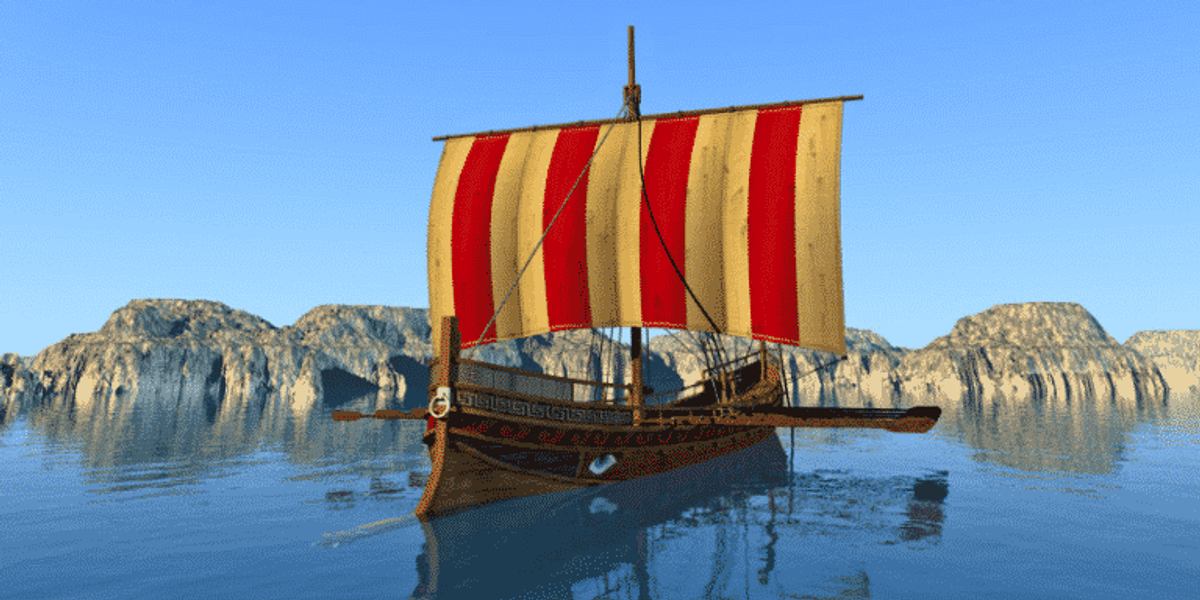
What does corporate governance have to do with steering a ship in Ancient Greece?
Quite a lot, as it happens.
The word “governance” ultimately traces its ancestry to the Ancient Greek verb kybernáō (κυβερνάω), meaning to steer or pilot a ship and, by extension, to guide or govern. The word subsequently travelled through the Latin gubernare and Old French before governance entered English in the late Middle Ages. The nautical ancestry is therefore more than an attractive modern analogy: it is embedded in the history of the word itself.
And although Plato did not invent either the word or the idea of comparing government with navigation, he gave the metaphor one of its most memorable expressions.
More than two thousand years later, it remains surprisingly relevant to the work of modern boards.
Plato's troubled ship
In Book VI of The Republic, Plato asks us to imagine a ship on which the sailors are constantly quarrelling about who should control the helm.
None has properly learned navigation. Indeed, they question whether navigation is something that can even be taught. Their energies are instead directed towards persuading, manipulating or overpowering the shipowner so that they can take control.
Meanwhile, there is someone aboard who actually understands navigation. The genuine pilot pays attention to the seasons, the weather, the winds, the stars and everything else necessary to navigate the vessel.
The others regard him as impractical and useless – a mere “star-gazer”.
Plato's immediate purpose was philosophical and political: he was explaining why someone possessing genuine knowledge might nevertheless appear useless in a political system that rewards quite different abilities. His sailors are skilled at obtaining the helm, but that is not the same thing as being skilled at steering the ship.
That distinction has lost remarkably little of its force.
Governance is still about steering
Modern corporate governance is obviously far removed from the political arrangements of classical Athens. We should therefore resist stretching Plato's analogy too far.
But the underlying idea of steering remains highly instructive.
The ASX Corporate Governance Council describes corporate governance as the framework of rules, relationships, systems and processes within and by which authority is exercised and controlled in corporations. It influences how corporate objectives are established and achieved, how risk is monitored and assessed, and how performance is optimised.
Similarly, the G20/OECD Principles describe corporate governance as involving relationships between management, the board, shareholders and stakeholders, together with the structures and systems through which the company is directed, its objectives established and its performance monitored.
Strip away the contemporary terminology and the ancient idea is still recognisable.
Governance concerns:
- where the organisation is going;
- who has authority to determine its direction;
- who is entrusted with the helm;
- what knowledge and information inform its course;
- how risks and changing conditions are detected;
- what constraints apply to those exercising power; and
- how they are held accountable for the journey.
Good governance is not simply having somebody at the wheel.
It is creating the conditions in which an organisation can be steered competently, ethically and accountably towards its objectives.
Having the helm is not the same as knowing how to steer
Perhaps the most interesting modern lesson from Plato's ship is his distinction between authority and competence.
Appointment to a board confers authority. It does not automatically confer the knowledge, judgement or behaviours required to exercise that authority well.
That is why board composition cannot sensibly be reduced to filling seats or satisfying a skills matrix mechanically.
Effective boards need an appropriate combination of industry knowledge, financial literacy, commercial experience, risk awareness, independence of mind, interpersonal skills and the capacity to understand an increasingly complex operating environment.
The OECD Principles accordingly emphasise strategic guidance, effective monitoring of management, objective and independent judgement and informed decision-making as central board responsibilities.
The modern director, of course, does not personally need to know everything.
But directors must collectively know enough to recognise:
- what information matters;
- what questions need to be asked;
- where management assumptions require challenge;
- when specialist expertise is necessary;
- when circumstances have changed; and
- whether the organisation remains on course.
The navigator does not control the wind. Good navigation lies partly in recognising what cannot be controlled and responding intelligently to it.
The same is true of governance.
Navigation requires information
Plato's genuine navigator studies the stars, winds, seasons and sky.
For a modern board, the navigational instruments are different, but the principle is similar.
Boards depend on good information.
Financial results, strategic indicators, risk reporting, customer data, regulatory developments, workforce information, competitor intelligence, scenario analysis and other forms of decision-useful information collectively allow directors to understand where the organisation is, where it may be heading and whether a change of course is required.
More information, however, does not necessarily produce better navigation.
A ship's bridge covered with hundreds of instruments would be of little use if nobody could identify which readings actually mattered.
The same problem occurs in boardrooms.
Excessively large board packs, poorly designed dashboards, retrospective reporting and information presented without context can create an appearance of comprehensiveness while obscuring the matters on which directors most need to exercise judgement.
Effective governance therefore requires not simply information, but information of the appropriate quality, relevance, timeliness and depth.
Direction matters before speed
There is another useful implication of the steering metaphor.
An organisation can be travelling very efficiently in the wrong direction.
Boards understandably devote considerable attention to financial performance, operational efficiency and implementation. But governance requires a prior question:
Are we heading towards the right destination?
Strategy and governance are therefore inseparable.
The OECD Principles place reviewing and guiding corporate strategy among the board's key functions.
A well-governed organisation needs sufficient clarity about purpose, strategy, risk appetite and priorities for management to understand not merely how fast it should travel but where the board expects it to go – and which routes it should not take.
Steering is not rowing
The metaphor also illustrates one of corporate governance's perennial challenges: the boundary between governance and management.
A board steers at a different level from management.
Directors should not ordinarily be down in the engine room adjusting machinery, nor should they attempt to take an oar from management every time conditions become difficult.
Their responsibility is to provide direction, make the decisions reserved to the board, monitor progress, oversee risk and performance, challenge constructively, appoint and oversee senior management and intervene when circumstances genuinely require it.
The exact boundary will vary according to the organisation and the circumstances. In a crisis, the board may need to become considerably more engaged. In normal conditions, excessive director involvement in operational decisions can itself weaken accountability.
Knowing when to hold the helm firmly and when to allow management to navigate within an agreed course is part of mature governance.
Good governance is not a straight line
There is one further reason I particularly like the ancient connection.
It helps explain something about the Governance in Action identity itself.
The company's logo deliberately has a Greek-inspired visual character. Its geometric form also resembles a maze – appropriate, perhaps, because corporate governance can sometimes feel remarkably like one.
There are laws and regulations, constitutions, board and committee charters, delegations, policies, stakeholder expectations, regulatory guidance, reporting obligations, industry standards, accepted practice and, increasingly, complex questions involving technology, cyber risk, artificial intelligence, sustainability and organisational resilience.
The answer is rarely found simply by following one straight line.
But a maze is not necessarily solved by moving faster.
It is solved by maintaining perspective, understanding where you are trying to get to, recognising dead ends and choosing the right path.
That seems an equally fitting metaphor for contemporary governance.
The destination, the helm and the crew
No metaphor captures the whole of corporate governance, and we should certainly not transplant Plato's political philosophy wholesale into the modern boardroom.
But his ship gives us a useful way of thinking about some enduring questions.
Who should have the helm?
What knowledge should they possess?
What information do they need?
Whose interests are they navigating for?
How do they know whether they remain on course?
Who challenges the navigator when the proposed route is wrong?
And what happens when conditions change?
The language surrounding governance has become vastly more sophisticated since the Ancient Greeks first spoke of steering ships.
The fundamental challenge has not.
Governance is still about steering – providing direction while navigating uncertainty, complexity, competing interests and changing conditions.
The tools have changed.
The sea has not necessarily become any calmer.
And possessing the helm has never, by itself, been enough.
Governance in Action Pty Ltd provides a broad range of governance-related services, which is outlined in its website.
David Cantrick-Brooks FGIA FCG, Principal & Director of Governance in Action Pty Ltd, would be pleased to assist with enquiries. Please feel free to reach out via LinkedIn or via gia.net.au.
AI-assisted tools and techniques were used here to support the research, drafting and editing of this publication. Responsibility for the final content rests with David Cantrick-Brooks.
Whilst accounting and legal terms and references may be contained in this publication, it does not constitute or purport to be or represent accounting or legal advice of any kind – whatsoever.Readers should seek their own independent professional advice.
Author's note
Why the Governance in Action logo?
The logo's Greek-inspired geometry reflects, in part, the ancient linguistic roots of “governance”. Its maze-like form carries another meaning: governance is rarely a simple or linear exercise. Good governance helps organisations find a path through complexity while maintaining sight of their destination.
General Disclaimer:
The information contained in this website is provided for informational purposes only and should not be construed as legal advice on any matter.
No person(s) should act, or refrain from acting, solely on the basis of the material contained on this website. Your access of this website, and any use that you may make of the information on it, is not intended to create, and your use does not constitute, a contractual relationship of any kind.
All material published by Governance in Action Pty Ltd on its website remains its property, with copyright attached, and all rights are reserved.